Enhancing the Shopping Journey with AI-Generated Review Summaries
Turning customer voices into clear, trustworthy insights led to a 15% lift in engagement and 7% rise in revenue per visit across platforms


Problem Statement
At Victoria’s Secret, confidence is everything, whether it’s in what you wear or how you shop. Around 98% of customers land on the PDP (Product detail)page to evaluate products, and the majority of our PDP traffic flows into the customer review funnel. However, 36% of customers drop off due to overwhelming, unstructured, and repetitive customer reviews.


Oh no !!
🥺
Taking too long to read
💔
Oops! Appeared twice
So many reviews
😢
Proposed Solution
To address this, the goal was to integrate AI-generated review summaries into the Victoria’s Secret shopping experience. This feature delivers a concise, insight-rich paragraph highlighting key product information, helping customers make faster and more confident purchase decisions.
Primarly Targeted USA 🇺🇸 Based Customers are:
Since most of our customer traffic originates from the USA

+
New Customers
Returning Customers Discovering New Categories
Key Impact
7%
🎉
Increased Add-to-Bag Conversion
6%
👏
Increased Revenue per Visit
6%
🤩
Faster
Purchase decisions
Global Collaboration with Cross-Functional Teams

My Role in Leading the Initiative
I led this project end-to-end, from design kickoff to execution, collaborating with cross-functional teams to gather insights, conduct research, and shape key design decisions. After aligning with business leaders and testing with customers, I refined the solution with the Tech team, resulting in improved usability and faster purchase decisions for customers.
OUR JOURNEY BEGINS
95% of Customers say that reviews matter to them
According to Baymard’s research experts and reports, 95% of customers rely on reviews when making purchase decisions, and 46% purchase products specifically because they can see customer reviews.

Existing Customer Review Funnel Experience on PDP
Our customer reviews influence 80% of purchasing decisions by providing real experiences, genuine feedback, and shared images that reflect how people actually feel about the product, and customers often take these reviews as personal recommendations.

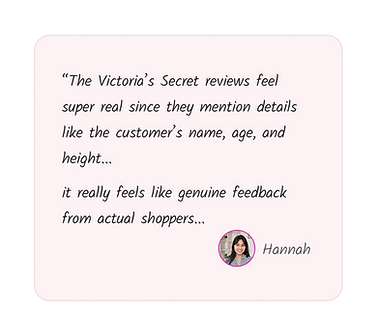
We share not only customer feedback but also details such as the product being reviewed, color, size, fit, and images. Additionally, we provide customer information like name, age, height, and badges to build trust and show that the reviews come from real customers.
Our Happy Customers Say
Some of the real appreciation comments from users about our customer review section during users interviews for PDP. Most of the users found the review section helpful for them are:


CHALLENGES
Where Our Customer Review Experience Falls Short
Our statistics report shows a 30% drop in customer review engagement over the past 6 months, which correlates with a 47% cart abandonment rate. This indicates that reduced review engagement may be contributing to lower purchase confidence.


FINDING CUSTOMERS PAIN POINTS
Understanding Customer Pain Points through Data and User Research
Our statistics report shows a 30% drop in customer review engagement over the past 6 months, which correlates with a 47% cart abandonment rate. This indicates that reduced review engagement may be contributing to lower purchase confidence.
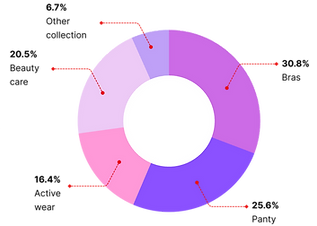
High-Demand Categories

Products with High Customer Ratings
Our Site’s Most Engaging Page

PDP (Product Details page)

Our Findings from Data
Considering the above data, I identified key insights by comparing performance over the last six months and highlighted the most significant points. These insights helped me define a direction for asking customers about their challenges and identifying which features we still need to retain.


In Our Customers’ Own Words
Collaborated with UX Research to identify gaps and understand why customers are not interacting with the Reviews section, along with other related insights

Assigned customers the task of adding a product to cart using reviews to identify challenges in the journey.

Key Insights from Customer Research
16 customers participated in the research. We assigned them tasks, addressed the challenges they faced, and observed their activities with confidence. From these observations, we extracted insights that helped us create customer-focused design problem and it’s solution are :

Re-defined Customer Problems
From our existing customer review experience, data analysis, and research insights, we identified the major pain points

The benefits of solving this customer problem are:
Customer Point of View
By solving this customer problem, customers will experience the following benefits

Business point of view
By solving this customer problem, our business can achieve the following positive impacts-

DESIGN APPROACHES FROM OTHERS
How Are Others Solving This Problem?
Leveraging data and customer insights, I analyzed competitor review sections to understand their design solutions, which could also inspire improvements in our customer experience
Competitors use AI summaries to simplify customer review insights
Through this process, I identified various AI summary features from competitors to improve our review experience

Highlights of AI Summary Features from Our Competitors
Extracted key insights from all the brands I covered in my comparative study, to a get design direct and further step

DESIGN DECISION
Our Design Decisions Based on Insights and Findings

UX HYPOTHESIS

Let’s Brainstorm Design Concepts
Based on all insights and initial design input, I brainstormed with the design team to define key points to ideate AI summary

Ideating Thoughts & Curiosity
After brainstorming, I am channeling insights into structured design explorations, shaping ideas into actionable solutions

3 Shortlisted Design Concepts
After exploring multiple ideas and iterating repeatedly based on genuine feedback to refine the concept design, I have shortlisted a few to discuss with stakeholders and assess technical feasibility
CONCEPT
AI-Genrative Summary with Key Attributes
Business point of view

Compare with Existing Design

Highlights
Strengths
Consideration
-
Clearly communicates to the user that this section is AI-generated, setting expectations upfront.
-
Provides quick, digestible insights such as product features, essential information, and usability, helping users scan important points quickly
-
Includes both positive and negative feedback in a concise paragraph, giving a realistic overview without overwhelming users.
-
Organizes information in a logical flow : title → key attributes → summary paragraph → feedback mechanism, making it easy to consume.
-
Users can grasp core product insights at a glance instead of reading hundreds of reviews
-
Summarizing multiple reviews prevents overwhelm from unstructured or repetitive content.
-
Including both positive and negative points increases credibility and authenticity.
-
Key attributes highlight product features and considerations, making the summary actionable for potential buyers.
-
If there are no reviews, this feature will not be applicable to that specific product and PDP page review section will be similar
-
If there are no negative reviews, only positive content will be shown in that case.
-
Even if a customer has only left negative comments, we will not display the AI summary features.
-
Ensure the AI correctly captures sentiments and key product aspects to avoid misleading summaries.
CONCEPT-2
AI summary with Paragraph
Proposed Design

Compare with Existing Design
Highlights
Strengths
Consideration
-
Integrated AI-generated summary directly in the Ratings & Review section.
-
Includes both positive and negative customer feedback in a single paragraph for a balanced view
-
AI summary title is customer-focused rather than emphasizing AI, keeping it relatable.
-
Feedback mechanism allows users to indicate whether the summary was useful.
-
Paragraph-style summary makes it easy for users to quickly grasp product sentiment.
-
Feedback mechanism guides future improvements and helps users assess content relevance.
-
Minimal design constraints; can be implemented with low development effort.
-
Aligns with overall design guidelines, ensuring consistency across the platform.
-
If no reviews are available for a product, the AI summary feature cannot be applied.
-
If only positive reviews exist, the summary will reflect only positive points.
-
Placement and length may need adjustment for mobile vs web experience to avoid clutter
-
Enhances user experience by reducing information overload from multiple reviews.
CONCEPT-3
AI Summary in Bullet Points
Proposed Design

Compare with Existing Design
Highlights
-
Summaries review in bullet points for quick scanning.
-
Shows negative and positive feedback with thumps up and thumps down icons.
-
Includes AI disclaimer to inform users it’s genrated from reviews
-
Feedback mechanism allows users to indicate whether the summary was useful.
Strengths
-
Easy to read and scan key points quickly
-
Visual icons make sentiment immediately recognizable.
-
Balanced view of product through positive and negative higlights
-
Encouges users trust through disclaimer transpancy
-
Collect user feedback to improve AI summary relevance.
Consideration
-
Ensure that AI correctly Identifies positive and negative points
-
Avoid too many bullet points to prevent clutter
-
Icons should be clear and universally understandable.
-
Disclaimer should be concise and readable.
-
Placement of feedback mechnasim should be noticeable but not distracting.
Initial Design Review with Cross-Functional Teams (AI, Tech, Product, Design)
Presented the design to the entire team, including PM, PO, UX researcher, Data Analyst, Developer, AI Engineers, and UX copywriter, to validate its feasibility and gather additional feedback, which provided direction for the proposed design


OPTION-2
AI-Genrative Summary with Paragraph
OPTION-1
OPTION-3
AI-Genrative Summary with Key Attributes
AI-Genrative Summary with Bullet


Why Option 1 is preferred by us
-
The paragraph summary connects all the review points, giving users a deeper understanding of the product.
-
This design helps users feel more confident in their decision by providing a full, cohesive picture, especially for personal items.
-
The single block of text is simple and uncluttered, making the page look professional and trustworthy.
-
This design approch is effortless to develop.
Option-1 (Not considered)
-
Requires users to process multiple data points, increasing cognitive load and hindering a quick understanding.
-
Requires a more sophisticated AI to categorize review data accurately, making it less feasible for a first-time implementation.
-
The design takes slightly more space to display the summaries, and adding new design components for key attributes cannot be processed quickly
Option-3 (Not considered)
-
The list breaks up the reviews too much. You miss the important connections between what people are saying.
-
It doesn't show how smart the AI is at understanding the full picture. The paragraph feels more complete and helpful.
-
Equal weight given to positive & negative, with eye flow moving from positive to negative
RE-ITERATION APPROCH
Improving Concept 2 : Toward Better Usability
After having a conversation with cross-functional teams, I have tried to incorporate most of their feedback in the second phase of design iteration

Based on internal discussions with the design, product, and tech teams, we shortlisted these three design concepts to present to business leaders before handoff. Let’s review the design changes and additional features
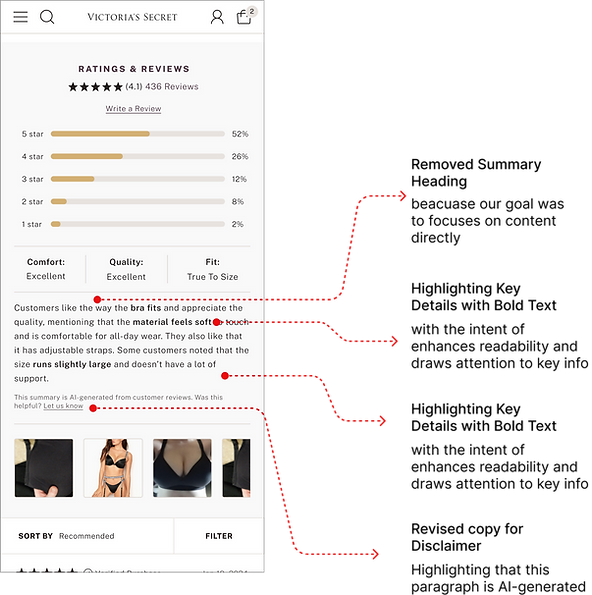
Design Iteration Highlights
Proposed Design

Re-Iterated Design
Proposed Design

Re-Iterated Design

Proposed Design
Re-Iterated Design


Design Experience for Feedback Mechanism


Design Options Presented to Leadership for Alignment

AI-Generated summary with paragraph
AI-Generated Summary with Keyword Filtered Customer Reviews
AI-Generated Summary with Horizontal Card Scroll

A Glimpse of Testing with New and Returning Customers
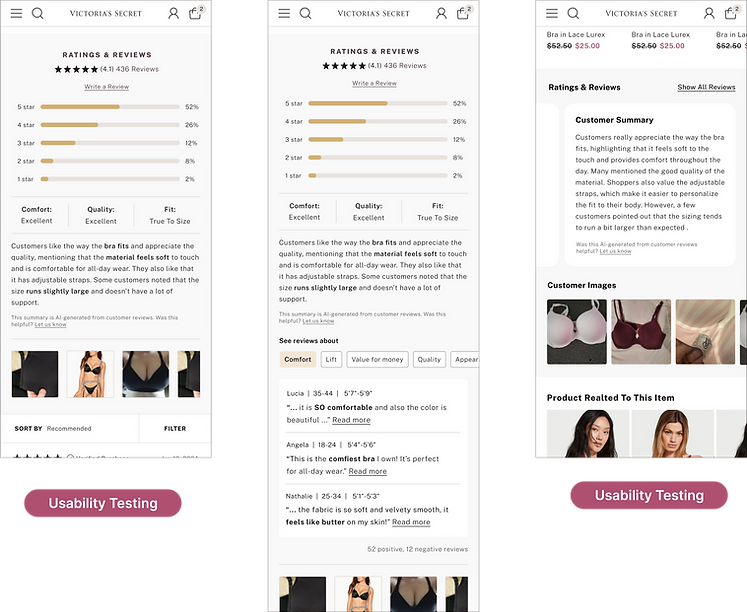
Conducted user testing with 22 customers. They appreciated and found the design option with the AI review summary more seamless. In contrast, with the individual summary card option, they found it difficult to recognize the AI summary because of the card-style treatment
77% Positive Response
to Design Option “ Summary with paragraph

33% Positive Response to Design Option “ Summary with Horizontal card scroll & collapsed Review summary

Final Design Hand off “ AI summary with Paragraph”
Considering user responses to Design 1 (‘AI Summary with Paragraph’), we are proceeding with this design solution. Here, we address the scenarios applicable for users, such as the error state, when a product has no reviews, and when a product has fewer than 100 reviews—showing how the design should look in each state.
M-web Experience
Product has more than 100 review
Product has less than 100 review or with no reviews
Error state
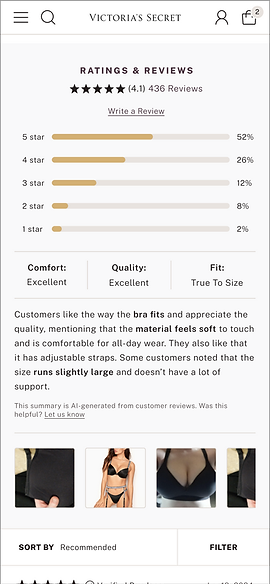


AI Summary Feedback Flow on M-Web

App Experience
Product has more than 100 review
Product has less than 100 review or with no reviews
Error state


AI Summary Feedback Flow on App

Web Experince
Product has more than 100 review

Product has less than 100 review or with no reviews

Feedback State

Our Final Design Prototype
M-web

App

Impact of AI Summary Design
M-web Results
🛒
13% increase
in customers adding products to cart
💡
29% of users
found the summary helpful for faster, confident decisions.
💬
17% of users
only clicked “See All Reviews,” indicating the summary met user needs.
🔁
15% boost
in the PDP review funnel, showing stronger interaction.
💰
7% increase
in revenue per visit, reflecting improved conversion efficiency.
⚠️
4% of users
found it not helpful, indicating strong adoption with minor improvement scope.
App Results
📈
15% increase
in customers adding products to cart within the last 28 days.
🤝
31% of users
found the AI summary helpful, especially for quick decision-making on mobile.
💰
7% uplift
in revenue per visit, confirming the summary’s influence on mobile conversions.
🔁
15% higher engagement
within the review funnel, showing users interacted more with summarized insights.
⚠️
3% of users
reported the summary was not helpful
Learnings
Users preferred short, scannable summaries but still wanted access to full reviews for context.
Users valued specific attributes (fit, comfort, size accuracy, fabric feel) over general positivity.
Mobile users especially appreciated AI summaries for reducing cognitive load during quick purchase sessions.
Emotional tone mattered — summaries that reflected real experiences and mixed sentiments felt more authentic.
Transparency builds trust — phrases like “summary is AI-generated from customer reviews ” or showing AI confidence levels reassured
Thankyou!